

Introducing AgentGuard® Chargeback
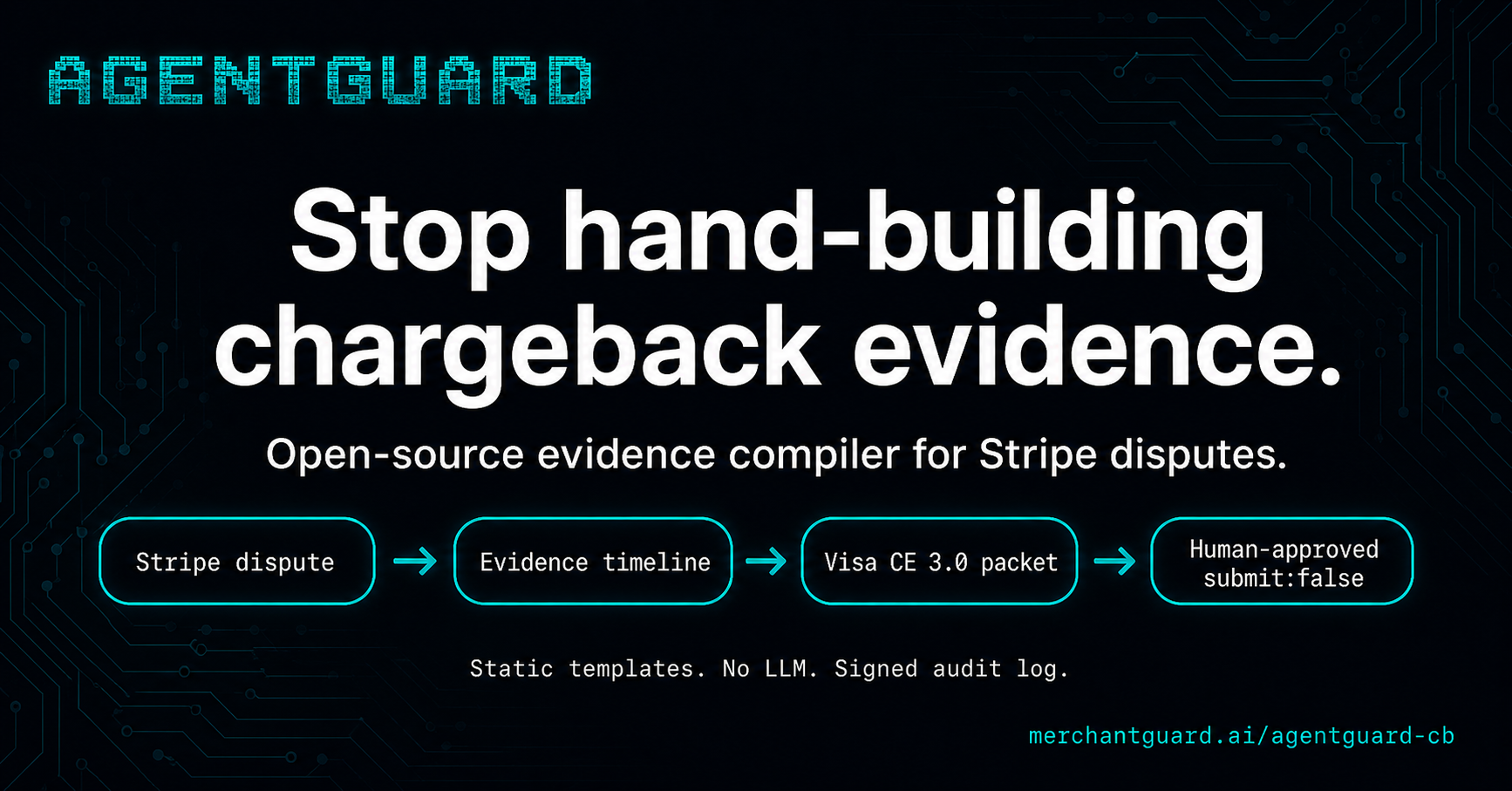
The open-source TypeScript SDK for assembling Visa Compelling Evidence 3.0 packets from your own production data. MIT licensed. Self-hosted. No LLM in the evidence pipeline.
A customer signs up. Uses your product. Disputes the charge.
Now you have two choices: accept the loss, or prove what happened.
The proof is usually scattered everywhere. Signup timestamp. IP address. Invoices. Product usage. Support emails. Terms accepted. Refund policy. Screenshots. The timeline of events. Most teams don't fight every dispute because assembling the evidence is miserable.
So we open-sourced the SDK that does the assembly.
What AgentGuard® Chargeback is
A typed, deterministic helper library that ingests your production events (Stripe webhooks, your CRM, your support tooling, your product analytics) and assembles them into the JSON shape Stripe's Disputes API expects for Visa Compelling Evidence 3.0.
npm install @merchantguard/agentguard-cb
Every staging call defaults to submit:false. A human on your team reviews every packet before it goes to Stripe. Every action is recorded in an Ed25519-signed, SHA-256 hash-chained audit log on your own infrastructure. The MCP server is read-only and pure-functional, so Claude Code, Cursor, Codex, or a local LLM (Ollama, LM Studio, Qwen-compatible runtimes) can drive it without ever touching the Stripe API.
What it does NOT do
AgentGuard® Chargeback is not a Visa Third Party Agent within the meaning of Visa Core Rules § 10.2.2. It is not registered under the Visa TPA Registration Program, and it has no contractual or technical relationship with Visa Inc., Stripe, Inc., or any acquirer. It does not file disputes on the merchant's behalf. It does not invoke any large language model in the evidence pipeline. It does not generate, fabricate, embellish, or modify evidence; the merchant's data is the merchant's data, and the SDK simply shapes it into the format Stripe's API expects.
Outcomes on any specific dispute are determined by Visa Resolve Online and the issuing bank under the Visa Core Rules. Submitting falsified evidence may give rise to civil or criminal liability under federal and state law. Read LEGAL.md and DISCLAIMER.md before deploying.
Why open-source this now
Regulators worldwide are converging on the same architecture: segregated counterparty accounts, hash-chained audit trails, human-in-the-loop approvals, no LLM-generated facts in regulated outputs. Brazil published Resolution 561 last week mandating those exact properties for cross-border crypto settlement (effective October 1, 2026). The U.S. CLARITY Act is in Senate Banking markup with the same architectural floor for stablecoin activity-based rewards. The EU MiCA already requires it.
The architecture should be public infrastructure, not SaaS rent. Our moat is the patent portfolio (multiple U.S. provisional applications pending) covering the underlying invention, not the SDK code. The SDK is MIT licensed with a defensive patent pledge modeled on LOT Network and Open Invention Network.
Quickstart
# 1. install
$ npm install @merchantguard/agentguard-cb

# 2. generate signing key (you generate, you hold)
$ npx agentguard-cb keygen > .dd.ed25519

# 3. ingest your first dispute
$ npx agentguard-cb ingest dp_xxx --sources=stripe,shopify

# 4. compile + stage (submit:false)
$ npx agentguard-cb stage dp_xxx
→ staged. review at https://dashboard.stripe.com/disputes/dp_xxx
For the typed library API and MCP tool catalog, see the documentation. For pre-answered questions on Stripe acceptance, Visa certification, fake-evidence risk, patent posture, and self-hosting, see the FAQ on the product page.
